48
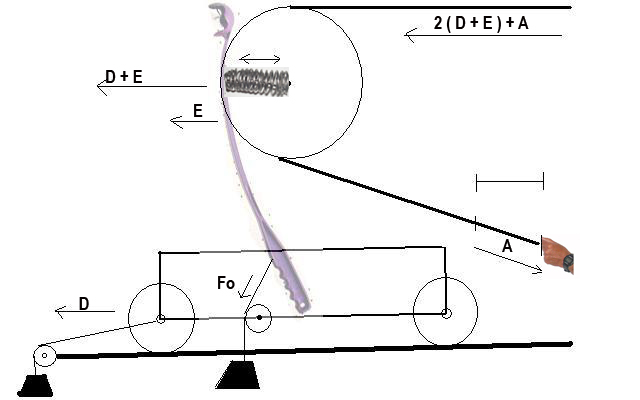
Putting it all together in a model would look like this:
Fig. 26
In terms of defining line speed, the rod hand is advancing (D). The rod/lever is rotating forward (force Fo) creating a tip-of-lever speed E…so the basic UN-hauled line speed will be D + E. ON TOP of that will be added the haul component, which is the D + E speed moving away from the hand ( 2(D + E)) AND the hand speed pulling actively backward (A).
So…potentially, in a perfect system…the total line speed is 2(E+F) + A. (Or is it greater?.....there is a lot going on here?) Compare that to the un-hauled line speed of D + E. That is a potential doubling!!! The rod/lever tip is still only going D + E. The line is moving seriously faster than the rod tip!!!!